How to Import Catalogs into Fast Video Cataloger
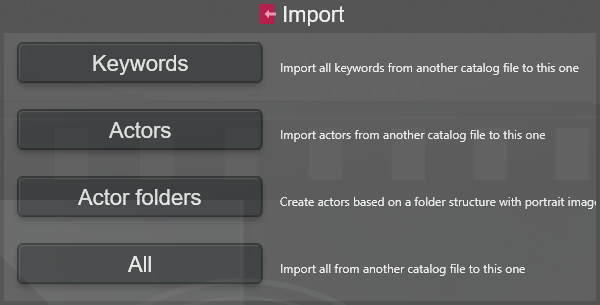
Fast Video Cataloger supports importing an entire catalog or only the keywords or the actors from a catalog. The import commands are on the Import page of the Start menu.
Import Keywords
The Keywords option imports all keywords from a selected catalog into the current catalog.
Import Actors
The Actors option will import all actors from another catalog into the currently active catalog. Once you have navigated, in the pop-up explorer window, to the catalog from which you wish to import actors, you will be presented with a list of actors to select from. If an actor has been imported before, it will be skipped. All actors can be imported regardless of whether they are used for a video or not.
Import Actors folders
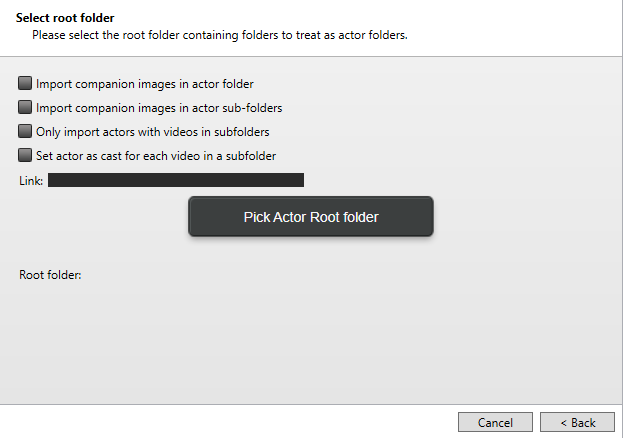
The Actor folders option allows you to import actors into your catalog based on a specific folder structure on your computer.
Starting at a root folder, every subfolder in this root folder should have Actor information.
Name of subfolder = Actor name
The first image in subfolder = Actor portrait
If a folder does not contain an image, it will be skipped. The wizard will help you get through the choices.
Import All
The All option allows you to import all videos from a selected catalog into the current one. Metadata linked to each video will also be imported, including companion images, keywords, and actors. If a video is already in the catalog, it will be skipped.
Videos whose file cannot be found, for example on a drive that is not connected, are imported too. The import normally compares file contents to recognise a video that is already in the catalog under another path; for a file it cannot read it only compares the path. When importing to a server, a video whose file cannot be found is not imported, because its file has to be uploaded.
Along with the videos come their date added, genre, colour label, scenes, transcripts and subtitles, extended properties, face detections, the visual search index, and the catalog's bins, playlists, keyword groups, archives, actors with their learned faces, and trained tags.
Importing into a catalog that already has some of this merges instead of adding it twice: a bin with the same name in the same place, a playlist with the same name, an archive with the same title and device, a keyword, a keyword group or a trained tag with the same name are used as they are, and get only what they do not have yet. Importing the same catalog twice adds nothing the second time.
User accounts and API keys are not imported: a shared catalog keeps its own.